I have been invited to present at Chautauqua Institute this summer. (https://www.chq.org/) I will be presenting a lecture followed by Q&A on the religious response to climate change, our obligations and our approaches. My lecture is scheduled for Monday, July 24th @ 2:00pm in the Hall of Philosophy. Woohoo!
Category: Uncategorized
Eggplant Pie – Southern Style
Eggplant Pie #1
- One eggplant, peeled and chopped
- Salt
- 1 TBL butter
- Splash of milk
- 1 egg
- Corn FlakesTM
- Cheddar Cheese, shredded
Preheat oven to 350oF or 180oC
Boil the eggplant in a pot of salted water until soft, about twenty minutes. Drain off water. Using a potato masher, mash the eggplant into a paste. Add the milk, a couple pinches of salt and two fistfuls of cornflakes crushed in your hands. Stir. Add egg and stir again. Place mixture in glass pie pan and cook twenty minutes until set.
Remove pie from oven. Dot top with bits of the butter. Take two more fistfuls of cornflakes crushed in your hands and cover the top of the pie. Top with shredded cheese and return to oven for ten minutes.
Because Corn FlakesTM contains a goodly number of industrial food ingredients, the first recipe is not recommended for those with food sensitivities.
Eggplant Pie #2
- One eggplant, peeled and chopped
- Salt
- 1 TBL butter
- Splash of milk
- 1 egg or egg white
- ¼ cup almond flour
- Breadcrumbs
- Cheddar Cheese, shredding
Preheat oven to 350oF or 180oC
Boil the eggplant in a pot of salted water until soft, about twenty minutes. Drain off water. Using a potato masher, mash the eggplant into a paste. Add the milk, a couple pinches of salt and the almond flour. Stir. Add egg and stir again. Place mixture in glass pie pan and cook twenty minutes until set.
Remove pie from oven. Dot top with bits of the butter. Cover the top of the pie with a thick layer of breadcrumbs. Top with shredded cheese and return to oven for ten minutes.
Cooking Wine

Simple and Inexpensive
- Cheapest bottle with a screwtop
- Add 2-3 TBS kosher salt
- Shake to dissolve (it will foam)
Bonus
- Open an awful bottle, add it to the cooking wine bottle
Stovetop Focaccia
This recipe uses an 8” cast iron skillet with lid.
Ingredients
- 2-1/2 cups “OO” flour
- ½ cup semolina flour
- 1tsp salt
- 1 TBS instant yeast
- 3 TBS olive oil
- 1 cup warm water
- Extra oil and kosher salt set aside for cooking
Ten minutes of prep if using a food processor:
Mix flours and stir once.
Add salt and stir once.
Add yeast and stir twice.
Add olive oil one TBS at a time and stir once each time.
Add water and stir until dough forms.
Roll out dough onto plastic wrap. Work the dough until a ball is formed, sprinkling extra flour if dough is too wet and sticky. Wrap loosely in plastic and let rise on counter for a half hour.
Have kosher salt and olive oil within reach.
Split dough into three batches. (I usually freeze the other two.)
Preheat skillet to medium heat
Roll out dough to fill bottom of skillet.
Coat bottom of skillet with oil and sprinkle liberally with salt.
Place dough in pan, paint the top of the dough with oil and salt as well. Cover with lid and set timer for 3 minutes.
Flip over dough, cover, and set timer for another three minutes.
Remove cover and reduce heat to prevent burning dough.
Set timer for two minutes, flipping the dough every 30 seconds.
Remove from pan; let cool slightly and serve.
The Social Contract and the Pandemic
The life of the spirit has taken a terrible beating these past few decades. From teaching MBA candidates that “Greed is good” to the hyper-politicization of moral stances for purposes of attracting votes and onward to the monetization of, well, everything, integrity and ethics have been downgraded in importance and denigrated as superfluous. In fact, some argue that having business ethics condemns integral people to lower incomes and worse prospects. As a result, the bond between the letter and the intent of laws, principles, and proclamations has come under ever expanding assault. The concept of the social contract, the spirit of the public square, has been abrogated.
*****
The pandemic is a good (which is to say, appalling) example of what happens when the Social Contract is broken. The corruption of the social contract was laid bare when the first wave of the pandemic rushed into New York City. The call was for a “shelter in place” order, a demand that all individuals lock themselves in their domiciles, emerging only for necessities when delivery was impossible. NYC became a ghost town as wisps of essential workers made their way to and from work with trepidation. The social contract was that if everyone sheltered in place, government would use the time to put in place protocols such as personal protection equipment, and implement initiatives, especially contract tracing to extinguish the spread. These steps would ensure that when everyone emerged from lockdown, economic, cultural, and social life would be able to restart safely, albeit slowly and carefully.
If the government response is an abrogation of the Social Contract, there are also examples of the broken contract at the individual level. Compare the Covid19 response to the easiest to understand functioning social contract: the obligation of the shopping cart. The spirit of cooperation between those who patronize the same store obligates the patrons to return the cart for other shoppers to use, who in return will do the same. Returning a shopping cart to the corral or abandoning it in the parking lot is a choice where there is no reward or punishment. Those who cannot honor the social contract without threat of punishment are bad actors.
Wearing a mask in public is an equivalent social contract. Currently, there is no exercised punitive government-sanctioned penalty for not wearing a mask in public places; owners and managers of venues make a choice to expel the unmasked. The reasons given for defying the mandate of wearing a mask ignore or even deny the existence of a social contract. The excuses do not mention any obligations that the community adopts. “My rights” trumping the social contract of wearing a mask is a clear case of the broken bond between the letter of the mandate and the spirit of the mandate. The same malignant dynamic plays out when gun-toting individuals mass in front of state capitols demanding the governor open businesses. Their demand of “their rights” is a repudiation of participation in social contract between fellow inhabitants of the land.
The social contract during this pandemic has not been fulfilled. Too many politicians and bureaucrats failed to accept and act on their responsibilities. Individuals and certain politicians decided their response to the pandemic would be based on politics and economics when the social contract obligated them to respond with science. Over 100,000 U.S. citizens have died thus far, and tens of thousands of them unnecessarily. The counts will continue to rise.
Social Contracts are not theoretical constructs; they are statements of human integrity. They are valid, powerful, and necessary components for any human endeavor. When such contracts are broken, institutions and communities are weakened and sometimes broken. In rare cases such as a pandemic, people die because of the breaking of the bond between letter and spirit.
A Little Bit of Vocabulary
Book whisperers have suggested that struggling with difficult texts is as much a moral or ethical discipline as an intellectual one. Real questions cannot be explored with simplistic solutions nor can real dilemmas be resolved with quaint moral exhortations. The issues of the day require drive, focus, and perseverance. Difficult texts are the result of complex problems that defy easy solutions.
To limit the amount of “mind candy” one consumes is good for the soul as much as the brain. Unfortunately, the online book purveyors push reams of pulp that make finding the better reads akin to hunting for the contact lens you dropped before putting it in your eye – you are going to cover a lot of territory before you find one. Online book sites have become unwieldy and often unusable without a good amount of preparatory work.
I finished Donald Harman Akenson’s “Surpassing Wonder: The Invention of the Bible and the Talmuds” after several years of picking it up and putting it down. The hardcover comes in at 623 pages of text, notes, and appendices. He had a few things to say.
Dr. Akenson’s breadth of vocabulary is extraordinary. When I bought the book at Farley’s Bookshop in New Hope, PA, they placed one of their paper bookmarks in the text. I kept a running list of vocabulary for which I did not know the definition on the back of that bookmark. I have heard of some of these words but was forced to admit I did not know the meaning. After page 294, I was forced to switch to an Excel file because the list kept growing. The last word comes from page 400.
Below is my vocabulary list from Dr. Akenson. I offer it as a little meat and potatoes instead of the usual tasteless pudding.
| semiotic | lapidary | apposite |
| prolix | atrabilious | tenterhooks |
| palimpsest | reliquary | equilibrations |
| valetudinarian | anodyne | pelf |
| parallax | hectoring | anechoic |
| conflate | aphotic | benisons |
| picaresque | colporteurs | propinquity |
| verisimilitude | fascicle | vergers |
| aniconic | adamantine | otiose |
| stratigraphy | incarnadine | hermetic |
| salvic | meretricious | apothegm |
| politesse | imbrication | perduring |
| brume | usucaption | |
| guying | autochthonous |
A Jewish Response to Climate Change

Under the auspices of New York Interfaith Power & Light, I’ve launched a new initiative, Aklim – A Jewish Response to Climate Change.
The old national initiative, Coalition of the Environment and Jewish Learning (COEJL), is defunct and its website is no longer functional. An updated approach to Jews and Climate Change is long overdue.
Of all of the religious traditions in the United States that have taken a stand on climate change, that it’s real and it’s human-made, the Jewish organizations have been one of the least active. This inertia needs to be rectified.
There are many great causes out there that deserve the imprint of the moral certainty of religion. All of these great issues of social justice are for naught though if we don’t address climate change. Indeed, many of these issues that stand as priorities today are effects of climate change. Immigration from Central America is rooted in climate change destroying the agricultural cycles in Honduras and Guatemala, leading to poverty and starvation. The corrupt regimes could not respond. The Syrian civil war begins with the rapid desertification of marginal lands in Southern Syria. Assad forcefully declined to help his migrating people, and years of frustration burst into protest and violence.
Politicians do not want to touch climate change. Climate change mitigation is messy and the U.S. pricetag begins at trillions of dollars. Further, the Fossil Fuel industry donates huge sums to political campaigns. They also fund political action committees to sabotage politicians who do not adhere to the fossil fuel industry directives, raising up challengers to unseat established legislators.
In one voice, the religious traditions need to rise up and place climate change as THE priority. It is time that all the Jewish denominations added their wherewithal to the struggle.
Lessons of the Book Search
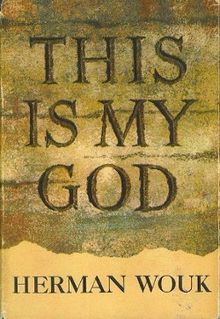
In the process of researching a new article-maybe-book, a down-the-rabbit-hole investigatory thread emerged. The origin of the thread begins with the novelist Herman Wouk (The Winds of War), a 20th century author of deserved literary repute. Mr. Wouk was also an Orthodox Jew, proud and practicing his faith so personally that he wrote a non-fiction text “This is My God.” His book is a well-written introduction to a Jewish theistic God concept, which is an accessible recommended read. In his introduction, Mr. Wouk explains that his book is in response to a derogatory text promoting agnosticism. The hunt began.
The book that invokes Herman Wouk’s ire has almost disappeared from library shelves in the first decades of the 21th century; in contrast, Mr. Wouk’s book is still in print and easily available. Homer W. Smith was a biologist in the first half of the 20th century who wrote three books of some publishing success. The third was “Man and His Gods,” published in 1955 and running at 485 pages before the index. However, what makes the book stand out is that the Forward is written Albert Einstein. The book sold well in its day.
As Dr. Einstein stated, Professor Smith attempts “to portray man’s fear-induced animistic and mythic ideas with all their far-flung transformations and interrelations.” One of the major arguments of the book is that Western religions are a magnet for all destructive fears that have haunted humankind. Further, these religions are also a significant broadcaster of these pernicious narratives that promulgate terrible results such as war and widespread unhappiness. The book is a thoroughgoing condemnation of religion and its application up through the beginning of the 20th century.
One can clearly understand why Herman Wouk despised this text.
There is no doubt that Professor Smith was extraordinarily well-read. Besides the Bible and biblical scholarship, he was intimately familiar with Enlightenment philosophers, the volumes of Gibbon’s “The Rise and Fall of the Roman Empire,” Darwin along with his milieu of detractors and supporters, Medieval magic and literature on the Devil, literary criticism, Christian theology and metaphysics. He saves some of his highest praise for the eleventh edition of Encylopedia Britannica, published in 1910-1911. (p. 483)
“Man and His Gods” is an archetypal text of its time. The writing is long-winded, and the grammar is complex, which was typical of the academic presentation of the day. Reviewers of that decade would declare that the book was erudite and well-written, whether or not they agreed the provocative argument.
The thesis is that knowledge and rationalism trump religion and superstition. Most of the text is a review of the religions of Western world and the Ancient Near East through history using the lens of 20th century rationalism. Professor Smith hoped to put the final nail in the coffin of superstitious religion with this book. He did not.
A funny thing happened though, which is why there was a hunt. “Man and His Gods” has nigh disappeared. In a dash of irony, I believe that the book would have certainly slipped away totally, despite a forward by Einstein, if Herman Wouk had not mentioned the text by name in his introduction. If Mr. Wouk had simply dropped a few sentences explaining his angry motivation for writing his book, time would have accomplished his goal for him.
I went searching for the text. My university lists a copy of Dr. Smith’s text in its catalogue, having purchased it in 1956. According to their records, the book was never checked out of the library. After I and the university librarian perused the shelf, we both concluded that the book had been stolen, probably decades ago. The Library of Congress (Card no. 52-5512) has a copy, buried in one of their offsite repositories. Having access to an academic national search function, someone located a copy at SUNY-Buffalo. Ten weeks after an initial request, I was holding the book.
The book did not meet my needs though. I was seeking a text that explained and promoted agnosticism in the 20th century. Dr. Smith’s text is the other side of the coin, exclusively attacking theism and orthodox religions. He states that rationalism is the better/best way, yet he offers no arguments for this stance. While the book may have made a splash at the time of publication, this lack of a positive argument may explain why the book disappeared from the great discussions on religion, culture, and individual relevance.
Having read through the book only to find the book only to find disappointment, I am reminded of a quote from the end of Ecclesiastes. “The making of many books is without limit and much study is a wearying of the flesh.” (Eccl. 12:9) Homer W. Smith taught me two lessons: first, erudition easily falls into hubris and second, pre-determined conclusions can produce a myriad of ever-escalating mistakes and misreadings.
Mr. Wouk’s book also taught me a lesson: Anger is a tool and it should never be a reason.
A Day after Pittsburgh Synagogue Massacre
Our tradition offers words of consolation, but we may not hear them until we can explain our pain. The wounds are raw and the deaths are fresh. At this time of aninut, the period before burial, we feel nothing and yet, we feel everything.
- Jews have enjoyed three hundred years fear from fear of communal violence in a blessed land until yesterday.
- We are proud to be Jews, but we thought we were seen as Americans first in this century.
- And like all people of good will in the United States, we believed that reason and optimism would overcome hatred and paranoid delusion.
We were not wrong.
The murderer may be a random actor, but I cannot see this senseless massacre as an isolated moment. The Sikhs were gunned down in Wisconsin. The black church members were slaughtered in the basement of their church in Charleston, SC. All of them and all of us were easy targets for hatred. We were people who believed in the possibilities of humanity and in the hope that prayer, good deeds, and acts of compassion could heal a divided world. We met the world with open arms instead of loaded guns.
The murderers were wrong though. The Sikh Gurdwara re-opened as did the AME Church. People came from all walks of life to sit with the survivors and to stand with the mourners. You must understand – a gun can kill a human, but it cannot extinguish humanity.
Historians have proven in European history that when Jews were persecuted, the country was already in or headed into great turmoil. The community of Jews was like a canary in a coal mine, a harbinger of great suffering to come. However, the persecutions in Europe were all, either state sponsored or church sponsored. History has no example of the great patchwork of ethnic and religious communities that make up the United States. Are the Sikhs, the African-American Christians, or the Jews the canary or all of us canaries? No, they are not and no, we are not. Our murdered brothers and sisters are victims and, as our tradition states, they are martyrs for their beliefs. We mourn with their families, friends, and congregation.
The massacre in Pittsburgh was directed at all American Jews. I hear that message, acknowledge it and hold my loved ones ever closer. The pain is personal, tapping into a history of martyrdom that I know far too well. I have known Jew-hatred, intimately. I have witnessed the hatred of the other through my eyes and my ears. Some people fear the world, and no law or principle will sway them from their hatred.
Please remember the great deeds our country has accomplished though. This nation has allowed the Jews to flourish as no other country in history has. The United States has offered the same opportunity to many, many other communities, which has made us as Jews doubly proud. We must pledge not be silenced by the hatred and the violence until it has been diminished and dismissed from the public ways and public discourses of this great nation.
In the coming days we will comfort our people and we will pray. Even more, we encourage our resolve to continue the fight for dignity and respect for all peoples who live within these borders. We must not respond to this tragedy with silence.
To our friends and well-wishers, please join with us as we pray, sit with us as we mourn, and when these first days have passed, join with us and let us together return grace to this nation. Nothing could give us greater solace.
End of the Holocaust Generation
I officiated at a funeral on Friday that I realized afterwards may be a consequential moment. The deceased was in her 90s and she was a Holocaust survivor. She was a very young child when Hitler came to power. The significance is that this may be my last funeral a Holocaust survivor, as most of them have passed.
I have buried a number of aged survivors over the years and always, the funeral and internment were unique points of sacredness. These funerals have been more complex than most, with unusual layers of meaning that have been shared but will not be spoken, and with more layers of meaning that have never been spoken and will be left unsaid, even though we, the next generation, know the content. God: mentioning God at a such a funeral is a minefield of accusation, futility, anger, regret and in rare moments, reconciliation. Yet, they requested a rabbi to officiate.
Holocaust humor is an extreme form of gallows humor, which often circles around the subject of God and God’s apparent impotence to save the Jews. While gallows humor seems to transcend generations, Holocaust humor appears to be quite specific to the immediate generation. I have had this bit of Holocaust humor sitting in my files for years, waiting for an appropriate context. The piece was left unused because the humor is biting and quite frankly, the opposite of what most people consider to be humor. Even more, placing the piece between paragraphs of context before and paragraphs of explanation after diminished the stark power of this humor.
The Holocaust generation is almost gone though, and this piece, with its contradiction and condemnation, should be preserved.
“A Jew dies. He ascends to the heavens and meets God. Standing before the Throne of Glory, the Jew tells God a Holocaust joke, but God does not laugh. When he realizes that God is not laughing, the Jew shrugs and says, “I guess you had to be there.”
My younger colleagues will never know the privilege of officiating at a funeral for Holocaust survivors. It is a privilege I never wanted and one for which a person could never prepare. Their presence in my rabbinate has been a blessing.
 Glenn Jacob